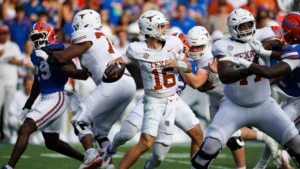
Arch Manning’s rocky start
Arch Manning entered the season wrapped in near-universal hype. He had a blue-chip pedigree and an elite recruiting profile. His preseason Heisman chatter made him one of college football’s most anticipated performers. Expectations were astronomical. Not just from fans and media, but from NFL scouts and the program itself. That context matters because performance and perception are always filtered through prior expectations, and early missteps now read louder than they otherwise would.
What’s gone wrong on the stat sheet and on film
- On paper: inconsistent completion rates, a middling yards-per-attempt mark, a handful of turnovers, and games where the offense looked stalled have produced numbers well below the preseason billing.
- On film: flashes of elite traits, velocity on the deep ball, mobility on designed runs and scramble plays. But they’re interspersed with timing errors, guarded mechanics at certain drops, and ill-timed decisions under pressure.
- Narrative signals: the opening-game outing against a top defense and a few high-success plays have amplified scoping bias. This could turn normal rookie growth pain into perceived alarming regression.
Individual factors: how much of this is on Arch?
- Transition to full-time starter: This is Manning’s first season as the unquestioned feature quarterback. The jump in snap count, defensive game-planning against him, and leadership demands create growing pains that can look worse when expectations are lofty.
- Mechanics and decision-making: There are correctable mechanical quirks and some decision-timing issues on intermediate reads; both point to process problems that coaching and reps can fix.
- Mental load and external pressure: The family legacy and preseason hype produce unusual scrutiny. Pressure can manifest as gripping the ball, forcing throws, or tentative reads. If these problem continue for Arch, they will no doubt continue to sap his consistency.
- Bottom line: Arch bears a large share of responsibility for on-field execution, but many of the visible issues are addressable through coaching, reps, and psychological resets rather than being intrinsic or permanent flaws.
System-level contributors: offensive line, scheme, and play-calling
- Offensive line instability: Multiple new starters up front has caused repeated sacks and hurried throws. Even elite QBs struggle to produce under chronic pressure.
- Receiver play and timing: Drops, poor separation, and route-running inconsistencies magnify quarterback mistakes. They also reduce positive plays on intermediate and deep concepts.
- Scheme fit and play-calling balance: If play calls put Manning into predictable third-and-long or force him into high-risk throws without sufficient quick-game or play-action balance, the box is stacked against him. Simplifying reads and leveraging his strengths (deep shots, RPO reads, play-action) could restore confidence.
- Coaching in-game adjustments: Slow or ineffective halftime corrections, or failure to mask protection or scheme issues, transfers blame onto staff planning and game management.
Shared accountability and the path to repair
- Shared responsibility: This is not a one-person failure. Offensive line cohesion, receiver consistency, scheme design, and in-game coaching all contribute materially to a quarterback’s ability to perform. The observable problems are an interaction of player execution and system shortcomings.
- Concrete fixes:
- Short term: simplify reads, increase quick-pass concepts, add tempo/change-of-pace plays to reduce sack/pressure frequency, and call more high-percentage throws to rebuild completion confidence.
- Medium term: technical work on footwork and release, targeted protection adjustments, and film-room emphasis on decision trees for open reads.
- Psychological: minimize external noise, controlled media plan, and mental-skills coaching to manage hype and reframe short-term failures as growth opportunities.
- Timeline expectation: Improvement should be visible within a few game-planning cycles if the staff adjusts protections and play-calling, and within weeks to months on mechanics and confidence with consistent reps.
Final read
Arch Manning’s season so far looks like a classic, high-profile growing pain. There are real issues at the micro level (mechanics, reads) compounded by macro problems (protection, scheme, external pressure). Blaming only Arch ignores the network of causes that create the outcomes fans see. Blaming only the staff or line ignores the quarterback’s central role in execution. The most useful frame is to be pragmatic. Texas needs to identify which problems are structural and which are coachable, apply focused fixes, and measure progress by fewer negative plays and steadier decision-making over the next several games. If those corrections happen, the narrative will shift from “struggle” to “development,” which is exactly where a young, hyped quarterback should be in his first season under center.