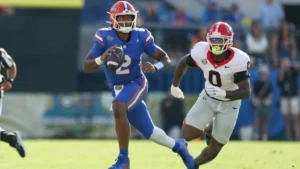
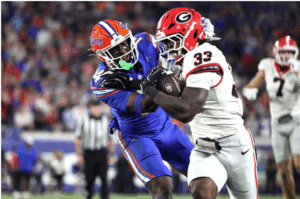
Game context and immediate storyline
Florida made a coaching change the week of the game, with Billy Napier fired and wide receivers coach Billy Gonzales installed as interim, which framed Jacksonville as a reset moment for the Gators and added volatility to their preparation and performance.
Final score and short recap
Georgia defeated Florida 24–20 in a tightly contested World’s Largest Outdoor Cocktail Party in Jacksonville, a game that featured multiple lead changes, field goals from both sides, and a late fourth-quarter push that decided the outcome. The box score and play-by-play show an even battle through three quarters before Georgia’s late push produced the decisive margin.
Key moments and decisive phases
- Georgia’s fourth-quarter execution — the Bulldogs produced a late scoring drive and made a critical defensive stand that preserved the win, continuing a season-long pattern of late-game comebacks and close finishes for this roster.
- Special teams and the kicking game factored into field position and scoring (multiple field goals were made for each team), keeping the margin narrow through the second half.
- Turnovers and situational penalties at key moments prevented Florida from seizing full control when momentum briefly shifted their way in the first half.
What worked for Georgia
- Resilience and clock/late-game management: Georgia again demonstrated the ability to finish games, converting late opportunities and relying on disciplined situational play to close out a rivalry game.
- Quarterback play and efficiency: The Bulldogs’ passing game maintained efficiency enough to move the chains when required and set up manageable scoring chances late in the game.
- Depth and game-control mentality: Georgia ran more plays overall and sustained enough drives to keep Florida off balance; that control of tempo contributed to wearing the Gators down by the fourth quarter.
What Florida showed and where it fell short
- Chaos from the sideline and personnel instability: The midweek coaching change injected short-term motivational energy but also forced schematic adjustments and leadership turnover that make consistent execution harder to sustain.
- Missed opportunities in critical phases: Florida had possessions and field-goal-range chances they couldn’t convert into the kind of game-clinching scores needed to flip a close rivalry game away from Georgia.
- Offensive inconsistency and turnover risk: The Gators have flashed playmakers and production at times this season, but turnovers and inconsistent third-down performance have limited their ability to sustain drives against upper-tier SEC opponents.
Short-term roadmap — Georgia
- Focus: tighten pass rush and defensive consistency. Georgia’s roster and coaching have the talent and culture to win the SEC, but their success this season has leaned on late rallies rather than early dominance — reducing the need for fourth-quarter heroics will be crucial against upcoming ranked opponents.
- Tactical adjustments: increase pressure packages without sacrificing coverage integrity; diversify run-pass balance earlier in games to avoid playing from behind and to preserve the defense late.
- Stakes and schedule: Georgia remains very much in the SEC title picture; sustaining health, minimizing penalties, and leaning on depth across the defensive front will be the practical levers to maximize the next month of the schedule.
Short-term roadmap — Florida
- Coaching process and culture reset: the program must use the remainder of the season to stabilize leadership, define a hire or longer-term direction, and reduce turnover in game-planning so players can focus on fundamentals and execution rather than scheme changes.
- Offensive identity and ball security: Florida needs a clearer plan to protect the football and convert third downs. Keeping DJ Lagway (and other playmakers) in high-percentage situations while rebuilding line play and situational decision-making should be priorities.
- Recruiting and portal management: the staff must act decisively in the portal and in recruiting to replace any immediate gaps created by the coaching change and to build depth that prevents close loses like this from becoming a trend.
Concrete tactical recommendations (what I’d want each staff to fix this week)
- Georgia: emphasize earlier offensive aggression to avoid relying on late comebacks; increase situational blitzes on third-and-medium where opponents have exploited soft pressure; rotate defensive linemen to keep the pass rush fresh late.
- Florida: simplify play-calling to reduce mistakes (fewer high-risk scripted plays until the new coach settles in); practice two-minute and red-zone scripts obsessively to turn close games into wins; prioritize ball-security drills and discipline on special teams.
Quick takeaways
- Georgia: the win preserves their SEC ambitions and validates a “do not quit” identity, but late-game reliance is a vulnerability against elite opponents if it becomes habitual.
- Florida: the loss under interim leadership exposes how tenuous a season can become after a coaching change; the program’s near-term task is stabilizing culture and execution while the administration answers the larger coaching question.